Evaluating 136 Nurikabe Puzzles as a Resource for Puzzle Books
For anyone considering publishing or using a puzzle activity book, the specifics of the product are crucial. A resource titled 136 Nurikabe Puzzles presents itself as a complete interior package designed primarily for Kindle Direct Publishing (KDP). It is, essentially, a template or ready-made book interior filled with a specific type of logic puzzle. Understanding what this offering entails, how it compares to other approaches for creating such content, and where it fits best requires a practical look at its components, inherent tradeoffs, and the audience it serves.
What Is the 136 Nurikabe Puzzles Activity Book?
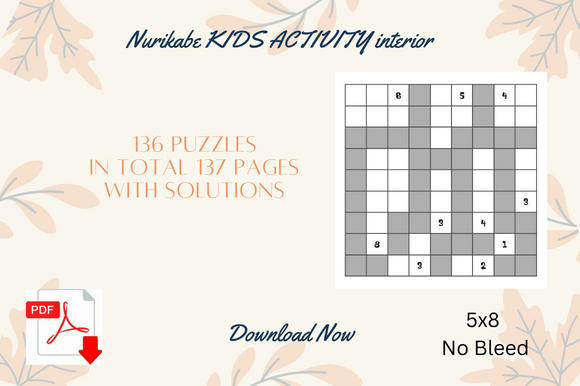
At its core, 136 Nurikabe Puzzles is a digital product: an instant download PDF file. It contains a complete set of worksheets for an activity book, centered on the Nurikabe puzzle game. Nurikabe is a Japanese logic puzzle where players fill a grid with black and white cells according to numerical clues, aiming to create a single, continuous "island" of white cells while ensuring black cells form a connected "wall" without forming pools. This particular package is branded as an "Easy" level collection, suggesting it's aimed at beginners or younger solvers.
The technical details are clearly outlined: it’s formatted for a 5"x8" trim size (a common paperback dimension) with no bleed, meaning the content does not extend to the edges of the page. It includes 136 distinct puzzles paired with 136 solutions, arranged with two puzzles per page and two solutions per page, totaling 137 pages in the PDF. The seller states it has passed Amazon KDP's quality check, which is a significant point for publishers wanting to avoid formatting rejection. This is not a physical book; it is the interior content one would upload to KDP to create a physical or digital book.
Distinct Characteristics and Comparative Context
When evaluating 136 Nurikabe Puzzles, it’s helpful to compare it against the broader landscape of creating or sourcing puzzle book content. The main alternatives typically fall into three categories: creating content entirely from scratch, using piecemeal templates or generators, or purchasing similar complete interiors from different creators.
The From-Scratch Approach
Designing a Nurikabe puzzle book from scratch involves generating original puzzles, ensuring logical consistency and a gradual difficulty curve, designing the layout, and formatting pages meticulously. This approach offers maximum control and uniqueness. You can tailor the difficulty, theme, and presentation exactly to your vision. However, the tradeoff is immense time investment and required expertise in both puzzle creation and graphic design. For someone without those skills or time, this path is prohibitive. 136 Nurikabe Puzzles eliminates this burden by providing a pre-generated, pre-formatted bulk of content.
Using Software and Generators
Another alternative is using puzzle-generation software or online tools to create puzzles, then manually compiling and formatting them into a book layout. This can be more flexible than a fixed template—you might control the number, grid size, and difficulty. However, it introduces a middle layer of work: you must run the generator, curate the output, and still handle the page design and assembly. The comparative advantage of 136 Nurikabe Puzzles is its immediacy and completeness. It is a finished compilation; the generation and assembly work is already done, saving hours of manual labor. The tradeoff is the lack of customization; you accept the puzzle selection and "Easy" level as given.
Other Pre-made Interiors
The market for KDP interiors includes many similar products across various puzzle types (Sudoku, Word Search, Mazes). Comparing 136 Nurikabe Puzzles to these, its distinctiveness lies in the puzzle niche itself. Nurikabe is less ubiquitous than Sudoku, potentially appealing to a specific audience seeking new logic challenges. The package's value proposition hinges on the quantity (136 puzzles) and the claimed KDP compatibility. When comparing, a buyer would assess puzzle variety, clarity of presentation, and the reputation of the source for quality. The inclusion of solutions is a standard but essential feature, and having them neatly formatted is a practical benefit.
Strengths and Ideal Use Cases
The primary strength of 136 Nurikabe Puzzles is convenience. For a publisher looking to quickly list a niche puzzle activity book on Amazon without design skills, this product dramatically lowers the barrier. The ready-to-upload PDF, tested for KDP, reduces technical risk. The volume of puzzles offers substantial content, making the resulting book feel substantial. The "Easy" designation and clean two-per-page layout make it suitable for an audience of older children, teens, or adults new to Nurikabe.
This resource is likely the right choice in several specific scenarios:
- For KDP Publishers Exploring Niche Categories: If you want to test the market for logic puzzle books without investing in custom design, this serves as a low-cost, rapid template.
- For Educators or Parents Seeking Structured Material: While designed for KDP, the PDF could also be used as a source of worksheets for classroom or home activities, given the easy level and included solutions.
- For Those Prioritizing Speed Over Customization: When the goal is to have a product ready for sale or use in days, not weeks, this pre-packaged solution fits perfectly.
The fixed format and puzzle count also provide predictability. You know exactly how many pages the book will be and how it will look, which aids in planning pricing and description.
Limitations and Considerations for Alternatives
Despite its conveniences, 136 Nurikabe Puzzles has inherent limitations that might necessitate seeking another option. The most prominent is the lack of adaptability. The puzzles are preselected, all at an "Easy" level. If your target audience requires progressive difficulty—starting easy and moving to medium or hard—this single-level package won't suffice. A book with mixed difficulties might be more engaging and marketable.
Furthermore, the interior is a template. It does not include cover design, title page, preface, or instructions. A publisher must still create or source those elements separately to complete a book. While this is normal for KDP interiors, it’s a factor in the total workload.
Another consideration is originality. Since this is a template sold potentially to multiple buyers, the interior content itself is not exclusive. The puzzles themselves might appear in other books using the same source. For a publisher wanting a unique product to establish a brand, this could be a drawback. In such a case, the from-scratch or customized generator approach, despite being more laborious, becomes necessary.
The specific puzzle type itself is a factor. Nurikabe has a dedicated but smaller fanbase compared to Sudoku or Crosswords. If market research suggests a broader puzzle type would sell better, then an interior package focused on those puzzles would be a more suitable alternative.
Key Decision Factors
When deciding if 136 Nurikabe Puzzles is the appropriate resource, consider these practical questions:
- Skill & Time: Do you have the ability and time to create and format 136 original puzzles? If not, this template addresses that gap.
- Target Audience Difficulty: Is "Easy" the right level for your intended users? For kids' activity books or introductory books, it likely is. For seasoned puzzle enthusiasts, it is not.
- Need for Uniqueness: Is having a one-of-a-kind puzzle collection critical for your project? If yes, this shared template may not align with your goals.
- Completeness of Project: Are you prepared to handle the additional tasks of cover design and book setup? This product only solves the interior puzzle content portion.
Making an Informed Choice
Ultimately, 136 Nurikabe Puzzles occupies a clear space in the ecosystem of puzzle book resources. It is a turnkey solution for a specific, niche content type. Its value is highest for those who view puzzle book creation as a publishing activity rather than a creative design activity—where the goal is to produce a viable product efficiently. It compares favorably to more labor-intensive methods by offering a tested, bulk quantity of ready material.
However, its fit is not universal. If your project demands customized difficulty, a mix of puzzle types, or total originality, then the tradeoffs of using this fixed template become significant. In those situations, investing in puzzle generation software, hiring a puzzle creator, or learning to design puzzles yourself might yield a better final product, albeit at a higher cost of time or money.
The practical examples are straightforward: a teacher needing a packet of logic puzzles for a summer camp might find this PDF perfectly adequate. An entrepreneur wanting to quickly expand their KDP catalogue with a new puzzle genre could use it effectively. A dedicated puzzle enthusiast aiming to publish a curated, progressive challenge book would likely find it too restrictive.
By understanding these distinctions, strengths, and limitations, you can better assess where 136 Nurikabe Puzzles fits within your options. It is a tool that simplifies one part of the process dramatically, but like any template, its usefulness depends entirely on how well its fixed parameters match your variable needs.